 ENG
ENG
 INA
INA
General Pathology and Non-Reproductive Pathology Research Group
GENERAL PATHOLOGY AND
NON-REPRODUCTIVE PATHOLOGY RESEARCH GROUP
Advancing Pathology for
Cancer, Tropical Diseases, Travel-related Diseases
Brief Description
The General Pathology and Non-Reproductive Pathology
Research Group is a multidisciplinary research platform dedicated to advancing
translational pathology in oncology, tropical diseases, and emerging
travel-related infections.
With over one decade of experience in diagnostic pathology,
immunology, and molecular biology, our team integrates histopathology,
immunohistochemistry, molecular diagnostics, and biomarker discovery to bridge
laboratory findings with clinical decision-making.
We collaborate with academic institutions, hospitals, and
international research partners to develop innovative diagnostic tools,
identify prognostic and predictive biomarkers, and contribute to precision
medicine—particularly in regions where cancer and tropical infectious diseases
intersect.
Background
Pathology remains the cornerstone of modern medicine. The
evolution from conventional morphologic diagnosis to molecular and immune-based
classification has transformed disease stratification, therapeutic targeting,
and prognostication.
In oncology, advances such as molecular classification and
immune microenvironment profiling have significantly improved patient
management. In breast cancer, for example, subtyping such as Triple-negative
breast cancer has highlighted the importance of molecular and metabolic
characterization in predicting metastasis and therapeutic response.
In neuro-oncology, updates from the World Health
Organization classification emphasize integrated histomolecular diagnosis,
particularly in entities such as Diffuse glioma.
Meanwhile, tropical and travel-related diseases continue to
pose diagnostic and public health challenges, especially in endemic regions
like Southeast Asia. Conditions such as Dengue fever, Malaria, and Tuberculosis
require robust pathological and immunological investigation to improve early
detection, severity prediction, and monitoring.
Despite technological progress, significant gaps remain:
- Limited integration of
immunopathology and molecular biomarkers in routine diagnostics in
low–middle income settings
- Insufficient characterization
of tumor–immune–metabolic interactions in aggressive cancers
- Underexplored pathology-based
biomarkers in tropical and emerging infectious diseases
Our research group was established to address these
challenges through an integrated, translational, and globally collaborative
approach.
Vision
To become a leading translational pathology research group
in South East Asia, advancing precision diagnostics and biomarker-driven
strategies for cancer and infectious diseases with global impact.
Mission
- Advance Translational Pathology
Integrate histopathology, immunology, and molecular biology into clinically relevant research. - Develop Biomarkers for
Precision Medicine
Identify diagnostic, prognostic, and predictive biomarkers in cancer and tropical diseases. - Strengthen Molecular and
Immunopathology Platforms
Expand capabilities in immunohistochemistry, digital pathology, and molecular profiling. - Foster International
Collaboration
Build sustainable partnerships with global research institutions and multidisciplinary consortia. - Capacity Building and Education
Train young scientists and clinicians in advanced diagnostic and translational research methodologies.
Research Roadmap
Phase 1 (Years 1–2): Foundation and Biomarker Identification
- Establish integrated biobank
for cancer and infectious diseases
- Immunohistochemical profiling
of tumor microenvironment and inflammatory markers
- Molecular characterization of
high-risk cancer subtypes
- Immune profiling in severe
tropical infections
Key Outputs:
Peer-reviewed publications, biomarker panels, national research grants.
Phase 2 (Years 3–4): Translational Integration
- Multi-omics integration
(genomic–proteomic–immunologic data)
- Development of predictive
models for metastasis and severe infection outcomes
- Validation studies in
multicenter cohorts
- Digital pathology and
AI-assisted diagnostic modeling
Key Outputs:
International collaborations, predictive algorithms, patent submissions.
Phase 3 (Years 5+): Precision and Global Impact
- Clinical implementation of
validated biomarker panels
- Personalized risk
stratification tools
- Policy contribution for
pathology-based diagnostic guidelines
- Regional center of excellence
for cancer and tropical disease pathology
Key Outputs:
Guideline contributions, global consortium leadership.
Core Research Themes
- Tumor metabolism and metastatic
potential
- Tumor–immune microenvironment
profiling
- Immunopathology of tropical
infections
- Biomarkers in travel-related
emerging diseases
- Molecular diagnostics in
resource-limited settings
- AI and digital pathology
integration
Why It Matters
Cancer and infectious diseases remain leading causes of
morbidity and mortality worldwide—particularly in tropical and developing
regions. Precision pathology is no longer optional; it is essential.
By integrating morphological expertise with immunological
and molecular innovation, our research group is committed to transforming
pathology from a diagnostic endpoint into a predictive, personalized, and
globally impactful discipline.
Research group member
|
Name |
Specialty/research focus |
Email |
|
Dr. dr. Ni Putu Sriwidyani, Sp.PA, Subsp. S.M.(K) |
Neuropathology Breast Pathology |
|
|
Dr. dr. I Wayan Juli Sumadi, Sp.PA, Subsp. M.S.(K) |
Musculoskeletal pathology |
|
|
dr. Herman Saputra, Sp.PA, Subsp.K.A.(K) |
Skin pathology |
|
|
Dr. dr. Ni Putu Ekawati, Sp.PA, M.Repro |
Gastrointestinal pathology Hepatobiliary & pancreas pathology |
Publication
1. The Relationship Between Poly-ADP-Ribose Polymerase-1 (PARP-1) Expression with Clinicopathological Characteristics of Nasopharyngeal Carcinoma in Bali, Indonesia, Indonesian Journal of Cancer, DOI: 10.33371/ijoc.v17i3.979, https://www.indonesianjournalofcancer.or.id/e-journal/index.php/ijoc/article/view/979
2. Identification of CDH4 Gene Copy Number Alteration and Its Association with Clinical Profile of Colorectal Cancer Patient, Indonesian Journal of Cancer, https://www.indonesianjournalofcancer.or.id/e-journal/index.php/ijoc/article/view/1135
3. High CD90 Expression is A Predictor of Axillary Nodal Metastasis in Breast Carcinoma, Indonesian Journal of Cancer, https://www.indonesianjournalofcancer.or.id/e-journal/index.php/ijoc/article/view/1085
4. GATA3 Expression in Breast Carcinoma Associations with Clinicopathological Features, Indonesian Journal of Cancer, https://www.indonesianjournalofcancer.or.id/e-journal/index.php/ijoc/article/view/1183
5. Differences in Pre-Operative Mean Serum Concentration of Thyroid Stimulating Hormone (TSH) and Free Thyroxin (FT4) in Patients with Benign Thyroid Nodules and Thyroid Carcinoma at Sanglah General Hospital Denpasar, Indonesian Journal of Cancer, https://www.indonesianjournalofcancer.or.id/e-journal/index.php/ijoc/article/view/813
6. Tethered Cord Syndrome in Patient with Lipomyelomeningocele A Case Study, Indonesian Journal of Cancer, https://www.indonesianjournalofcancer.or.id/e-journal/index.php/ijoc/article/view/852/436
7. Differences in Pre-Operative Mean Serum Concentration of Thyroid Stimulating Hormone (TSH) and Free Thyroxin (FT4) in Patients with Benign Thyroid Nodules and Thyroid Carcinoma at Sanglah General Hospital Denpasar, Indonesian Journal of Cancer, https://www.indonesianjournalofcancer.or.id/e-journal/index.php/ijoc/article/view/813
8. Histopathological Features of the Lung Parenchyma in a 64-Year-Old Male Patient with Post-COVID-19 Infection with Spontaneous Pneumothorax Dextra Due to AlveolarPleural Fistula (APF): A Case Report, Indonesian Journal Of Cancer, https://www.indonesianjournalofcancer.or.id/e-journal/index.php/ijoc/article/view/888
9. Early activation of macrophage-2 with IL-4 in stromal vascular fraction increases VEGF levels and adipocyte count and maintains volume of fat graft in Wistar rats (Rattus norvegicus), Narra J, https://www.narraj.org/main/article/view/1080/500
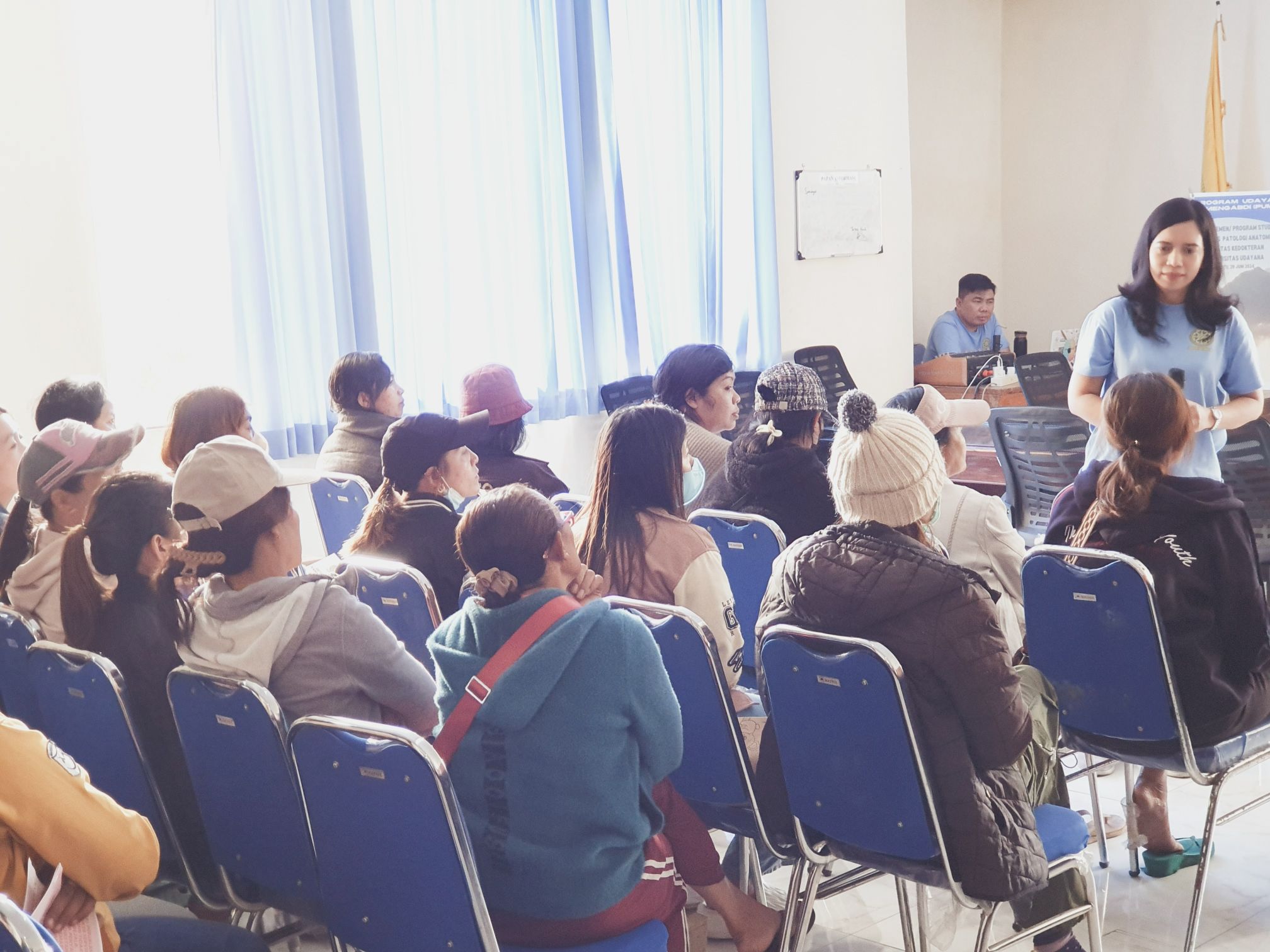
Community Health Programme
NO | JUDUL | Year |
1 | Training of Trainer Penguatan Kompetensi dan Peran Bidan Nusa Penida dalam Edukasi dan Pemeriksaan Pap Smear | 2024 |
2 | Penyuluhan dan Deteksi Dini Kanker Leher Rahim Melalui Pemeriksaan Pap Smear Di Puskesmas Kintamani I, Bangli | 2024 |
3 | Penyuluhan Deteksi Dini Kanker Leher Rahin dan Payudara serta Tirtayatra Pura Melanting, Desa Banyu Poh Kabupaten Buleleng | 2025 |
Collaboration
Domestic Partners
· RSUP Prof. Dr. I.G.N.G. Ngoerah
· Perhimpunan Dokter Spesialis Patologi Anatomik
Forms of Collaboration
· Multicenter research
· Scientific publications
· Training & workshops
· Data & technology exchange
Contact
Address: Secretariat of the Anatomical Pathology Specialist Study Program, Faculty of Medicine, Udayana University, Prof. Dr. I.G.N.G. Ngoerah General Hospital, Jalan Diponegoro, Denpasar, Bali 80114, Tel. +62 361 224662
Research Group Email: pathologi_anatomi@unud.ac.id
Website: https://pa.unud.ac.id/
Gallery



FACULTY OF MEDICINE, UDAYANA UNIVERSITY